Choose Lobster for pool freediving and Squid for depth. Lobster carries part of its weight in a flexible tail that rests along your upper back as you glide. Squid keeps the weight close to your neck and leaves the front of your throat clear for equalisation. Once you know which shape suits your discipline, the next decision is which set covers the weight you actually use.
Lobster vs Squid at a glance
| What to compare | Lobster | Squid |
|---|---|---|
| Designed for | Pool freediving, including dynamic apnea with or without fins | Depth freediving |
| What to check when trying it on | How the tail sits along your back with your arms overhead | Clearance at your throat and chin as you change position |
| Standard weight ranges | Small 1.5–2.5 kg · Medium 2.5–4.0 kg · Large 4.0–6.0 kg | PRO 0.8–1.3 kg · SPORT 0.8–1.6 kg |
| Adjustment | 100 g steps within each set’s range | 50 g steps on PRO · 80 g steps on SPORT |
| Other configurations | Additional tail segments are available separately | PRO SET reaches 2.0 kg and SPORT SET reaches 2.2 kg with the included Squid Heavy |
For the pool, choose a Lobster base you can adjust in the direction you need
During a pool glide, the Lobster tail follows the line of your spine. If you can try one at your club, bring your arms overhead in your usual streamline. Check how the base feels against your collarbones and how the tail sits when you move through a wall turn. See how Lobster fits.
Suppose you already use 2.5 kg of neck weight in the pool. Should you buy Small or Medium? Both can weigh 2.5 kg, but they reach it differently. Small reaches 2.5 kg with all its supplied segments fitted. Remove one and you can go lighter. The Medium base weighs 2.5 kg on its own. Add a segment and you can go heavier. At the same total weight, Small also carries some of that weight farther down your back.
That gives you a practical way to choose. If your usual pool setups include weights just below 2.5 kg, Small covers them. If they include weights just above it, Medium covers them with the segments in the box. The same question applies at 4.0 kg, where the Medium and Large ranges meet. Compare Lobster sizes and included segments.
For depth, choose between Squid PRO and SPORT
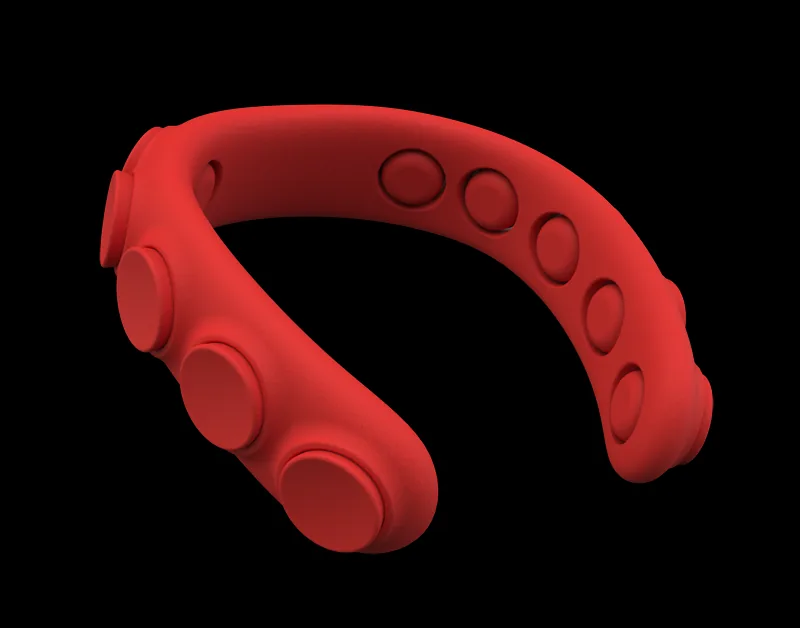
On a line dive, your body changes direction at the turn. Squid’s compact shape is designed to stay close to your neck through that change in position. When trying it on, check how it sits under your jaw and whether the open front gives you room to equalise comfortably in your usual wetsuit and hood. See the Squid fit and design.
PRO gives you finer adjustments. SPORT gives you a wider standard range. Both start at 0.8 kg. If your established setup falls within the range of both models, compare the adjustments you need when switching suits or dive sites. PRO lets you make changes of 50 g. SPORT uses 80 g segments and reaches 1.6 kg with the standard kit.
The SET option adds a Squid Heavy segment to the corresponding kit. Closure is a separate choice. The ring version comes with a T-lock strap and a cord. The magnetic version uses a nylon strap held by magnets in the base. Compare Squid versions and closures.
What if you train in both the pool and open water?
Choose your first neck weight for the sessions where you’ll use it most. If you spend winter training no-fins in the pool and join a depth course in summer, start with the Lobster range that covers your established pool setup. For the course, ask to try a Squid with your instructor in the suit you’ll wear on the line. That session will tell you how the collar fits and which settings you need for depth.
If you don’t yet know how much neck weight you use, establish that with your instructor before picking a set. The table is most useful once you have your own settings to compare. Read the guide to choosing a freediving neck weight.